Some hearts don’t fail loudly. They simply slow — beat by beat — until the rhythm that once filled a room with warmth grows dangerously quiet.
That was Marco’s story.
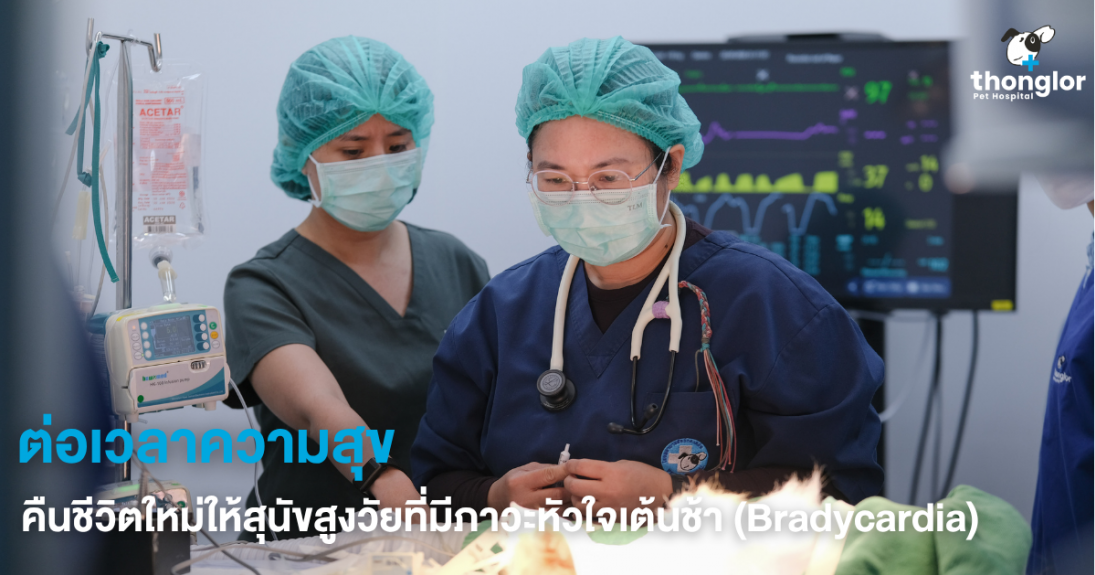
At 14 years old, Marco’s heart rate had dropped to just 20 beats per minute. A healthy dog his size should maintain a rate of 80 to 120 bpm. He already carried the weight of degenerative mitral valve disease and congestive heart failure. But this sudden, steep decline left his cardiology team at Thonglor Pet Hospital with one clear conclusion:
This could not wait.
Bradycardia is a condition in which the heart beats abnormally slowly, preventing adequate blood flow and oxygen delivery to the body’s vital organs. In senior dogs with pre-existing heart conditions, it can escalate into a life-threatening emergency within hours.
Signs to watch for:
Who is most at risk? Senior dogs with degenerative valve disease are particularly vulnerable to electrical conduction deterioration — the system that tells the heart when and how fast to beat. As the underlying disease progresses, the heart’s natural pacemaker can lose its reliability.
One day before the procedure, the full cardiology team gathered to map out every detail of Marco’s surgery. The room held cardiologists, surgeons, anesthesiologists, nurses, and OR staff — each bringing a different lens to the same question:
How do we give this heart its rhythm back?
For a 14-year-old patient with multiple cardiac diagnoses, nothing could be left to chance. The anesthesiology team paid particular attention to risk stratification — managing the delicate balance between sedation depth and cardiac stability throughout the procedure.
The team proceeded with a transvenous cardiac pacemaker implantation — a minimally invasive approach chosen to reduce surgical stress on an already-compromised heart.
Step-by-step:
1. Venous access A small incision was made at the neck to access the jugular vein — the primary route for lead wire insertion.
2. Lead placement The pacing lead was carefully threaded through the vein and guided into the right ventricle of the heart.
3. Fluoroscopic guidance Real-time fluoroscopy (live X-ray imaging) was used throughout to ensure precise lead positioning — critical for reliable pacing capture.
4. Generator implantation The pacemaker generator — a small, programmable device — was implanted subcutaneously at the back of the neck, away from movement-prone areas.
5. Device programming Once secured, the device was programmed to deliver electrical impulses at a rhythm appropriate for Marco’s specific condition and weight.
The surgery was a success.
In the recovery hours that followed, Marco’s transformation was unmistakable — no labored breathing, no seizures, eyes open and alert. By the time he was ready to go home, he was brighter and more energetic than his family had seen him in months.
Every beat of his heart, steady now, carried the quiet effort of an entire team that refused to give up on him.
Q: Can senior dogs safely receive a pacemaker? Yes. Age alone is not a contraindication for pacemaker surgery. Candidacy is determined through comprehensive health assessment — with particular focus on anesthetic risk evaluation for older patients with cardiac disease.
Q: How is a pacemaker implanted in dogs? In most cases, the lead wire is inserted through the jugular vein and guided into the right ventricle using fluoroscopic imaging. The generator is then placed under the skin, typically at the back of the neck. This transvenous approach is less invasive than open-chest alternatives.
Q: What is the difference between a dog pacemaker and a human pacemaker? The underlying technology is the same. The primary differences are in device size, implantation site, and lead access. In humans, generators are typically placed in the chest; in dogs, the jugular approach and neck implantation site are more commonly used.
Q: Will my dog be able to live normally after pacemaker surgery? Yes. Most dogs experience a significant and rapid improvement in quality of life following successful implantation — returning to normal daily activity. Routine follow-up appointments are recommended to verify device function and battery status over time.
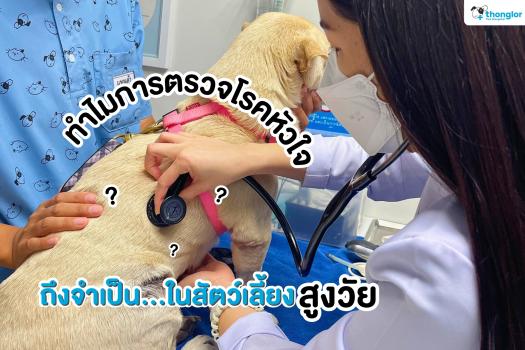
Q: How do I know if my dog needs a pacemaker? Your veterinarian will use an ECG (electrocardiogram) to measure heart rate and rhythm, combined with echocardiography and clinical history. If significant bradycardia is confirmed and does not respond to medication, pacemaker implantation is typically the most effective long-term solution.
Q: Does Thonglor Pet Hospital perform pacemaker surgery for dogs? Yes. Our Cardiology Center is fully equipped with fluoroscopy technology and staffed by an experienced multidisciplinary team that includes veterinary cardiologists, surgeons, and anesthesiologists specializing in cardiac cases.
A slow heartbeat, unexplained fatigue, or sudden collapse in your pet are signs that deserve immediate attention — not observation. Early diagnosis gives your dog the best possible chance at a full recovery.
Thonglor Pet Hospital — Cardiology Center
"For any inquiries regarding pet care, grooming, swimming sessions, or online shopping, feel free to reach out to us through the following channels:
#ThonglorPetHospital #TheBestAlways